

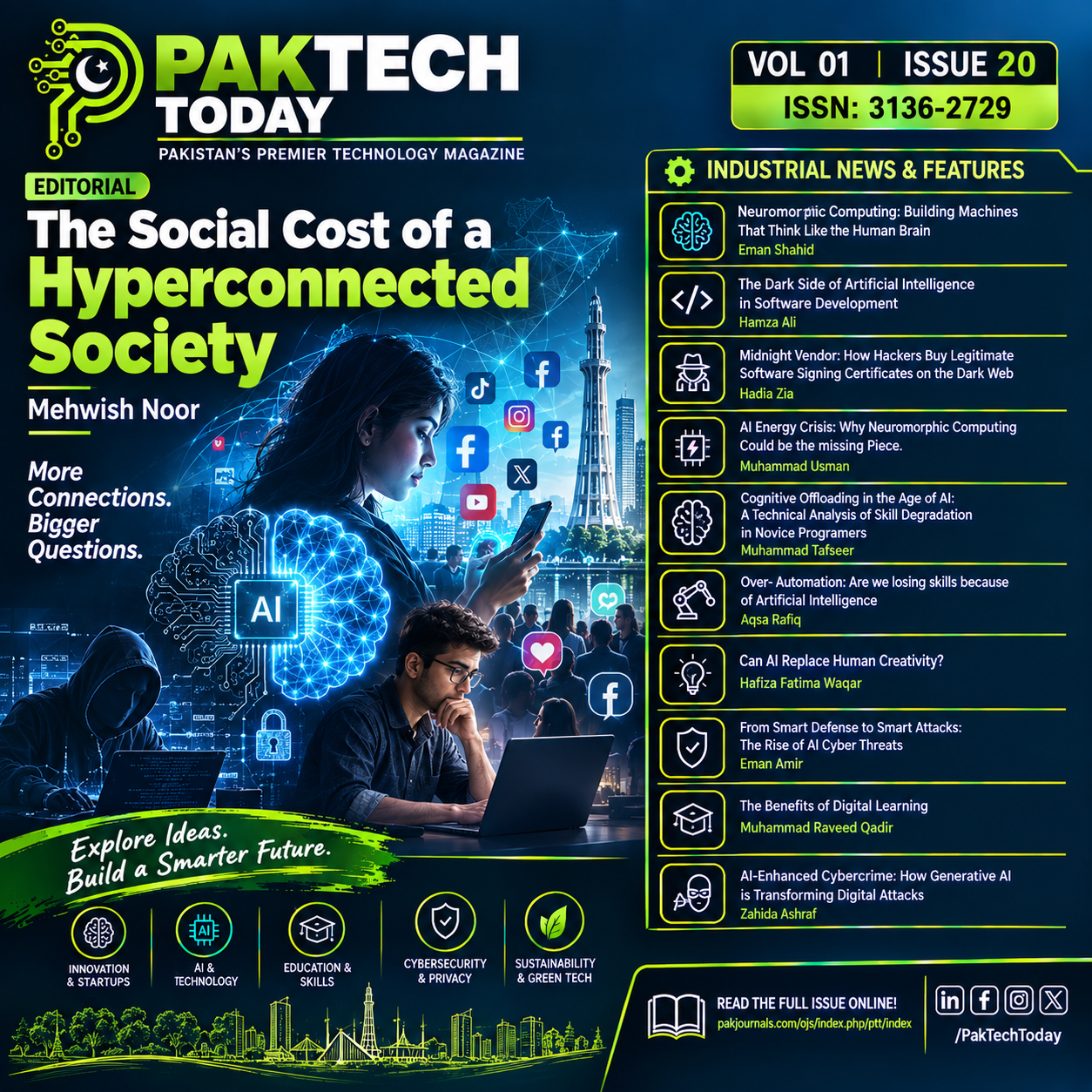
AI Energy Crisis: Why Neuromorphic Computing Could be the missing Piece. As the world is becoming weaker each day at an unprecedented rate, the brain-inspired neuromorphic chips have a groundbreaking solution to performing advanced AI consuming a fraction of the energy.
Article Sidebar
Main Article Content
Abstract
As artificial intelligence transitions from a digital novelty to a global industrial backbone, it has encountered a physical wall: the energy crisis.In 2026, the environmental and economic costs of maintaining massive, GPU-heavy data centers have become unsustainable. For nations like Pakistan, where a fragile power grid and skyrocketing circular debt clash with ambitious goals like the **National AI Policy 2025**, the traditional "brute-force" approach to computing is no longer viable. This article explores neuromorphic computing—a revolutionary hardware paradigm inspired by the human brain—as the essential missing piece to this puzzle. Unlike conventional Von Neumann architecture, which wastes immense energy moving data between separate memory and processing units, neuromorphic chips like Intel’s Loihi 3 and IBM’s NorthPole integrate these functions. By utilizing Spiking Neural Networks (SNNs), these chips operate on an "event-driven" basis, consuming power only when data "spikes" occur. This allows complex AI tasks to be performed at a fraction of the wattage—often reducing consumption from hundreds of watts to just over 1 watt. The implications for Pakistan are transformative. By shifting the focus from energy-hungry cloud infrastructures to Edge AI, the country can bypass grid constraints. This is particularly vital for the agricultural sector, where neuromorphic-powered UAVs can conduct real-time crop monitoring and disease detection without the battery drain associated with standard GPUs.
While the transition requires a significant shift in software engineering and developer education, Neuro morphic computing offers a path toward. It presents an opportunity for Pakistan and the Global South to deploy sophisticated AI systems that are resilient, affordable, and, most importantly, in harmony with their energy realities. The future of AI will not be measured by the megawatts we consume, but by how efficiently we can mirror the low-power brilliance of the human mind.
Downloads
Article Details

This work is licensed under a Creative Commons Attribution-NonCommercial-NoDerivatives 4.0 International License.