

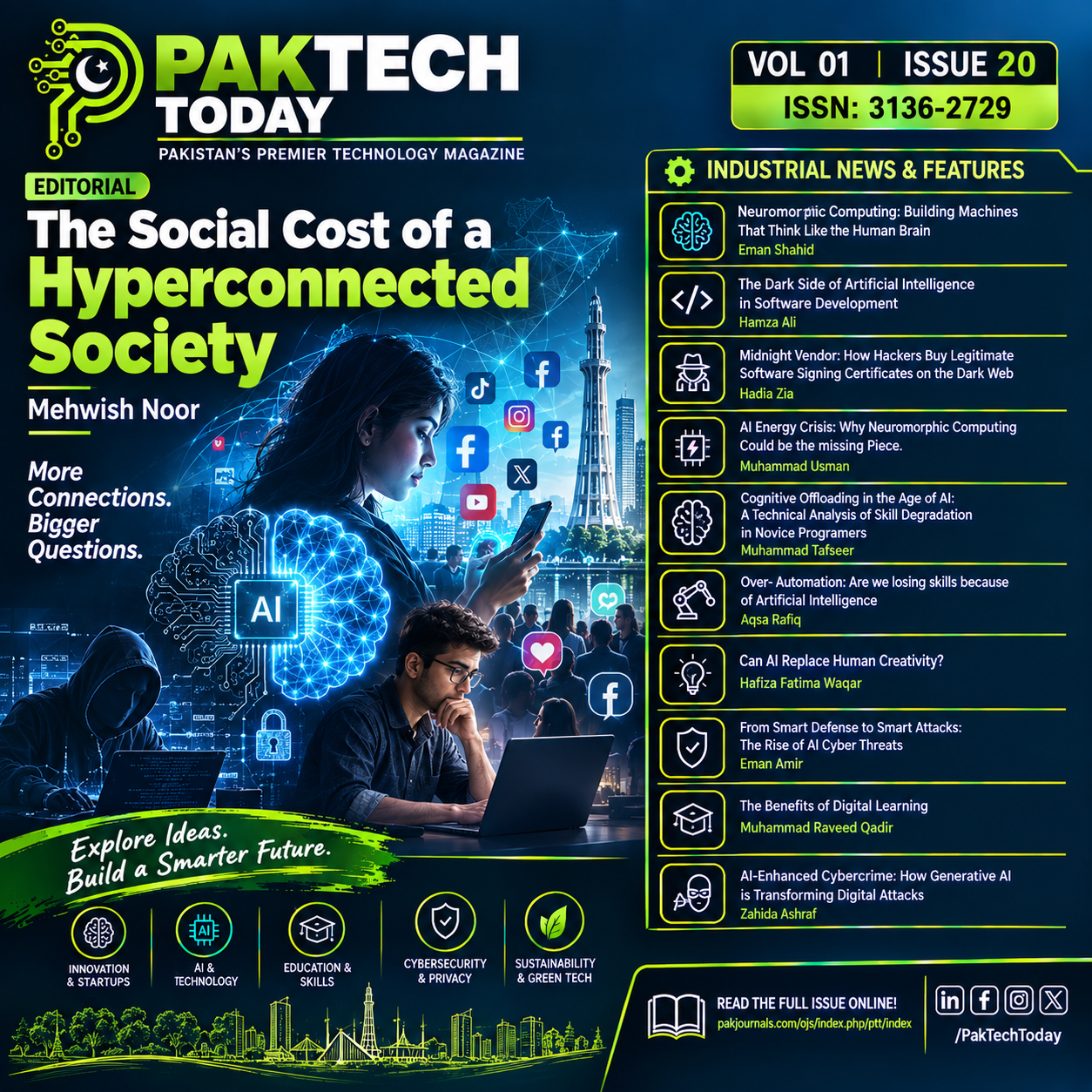
Cognitive Offloading in the Age of AI: A Technical Analysis of Skill Degradation in Novice Programmers An in-depth look at how Artificial Intelligence is quietly reshaping the mindset and capabilities of university students
Article Sidebar
Main Article Content
Abstract
This article examines the growing phenomenon of cognitive offloading among novice programmers in Pakistani universities. As AI tools like ChatGPT and Gemini become embedded in daily academic life, students are increasingly outsourcing their thinking to machines. While these tools offer genuine advantages in speed and accessibility, over-reliance on them is silently eroding the foundational skills of logical reasoning, independent problem-solving, and debugging. This piece explores the causes, consequences, and future outlook of this trend, and argues that the most capable developers of tomorrow will be those who use AI wisely — not those who depend on it entirely.
In modern time, tech and AI etc are not just tools, they have become a proper companion, a teache ,a friend. As technology is rising rapidly,people are getting more involved in it and relying more and more on it. People are using machines for many purposes and for every small move ,where once human thinking was required. This important factor called is cognitive offloading, where students ,researchers transfer their thinking and problem-solving responsibilities to external systems and machines. In programming, most of the freshers and juniors follow this trend and they just rely on the technology. Many novice and fresher developers now rely heavily on AI-assisted coding tools like open AI, Gemini ,Claude to generate solutions. They do this for ease ,for time saving .but this has a lot impact on their thinking. Gradually their own thinking abilities start decreasing. We can say advantage that it makes coding faster and more accessible, but it raises an important concern: are programmers still developing the ability to think critically and solve problems on their own?
Downloads
Article Details

This work is licensed under a Creative Commons Attribution-NonCommercial-NoDerivatives 4.0 International License.